High-Temperature Stress Analysis of Adhesively Bonded FGM Joints Using Finite Element Modeling

Adhesively bonded joints are a cornerstone of modern engineering design. They enable lightweight connections, distribute loads more uniformly than bolts or rivets, and allow for joining dissimilar materials without introducing stress concentrations from drilled holes. For these reasons, adhesive joints are widely used in aerospace, automotive, marine, and renewable energy structures.
When bonded components are made of Functionally Graded Materials (FGMs), the potential becomes even greater. FGMs are advanced composites whose properties vary gradually across their thickness, often combining metals and ceramics to achieve superior thermal resistance, stiffness, and durability. They are excellent candidates for high-performance environments where thermal gradients and mechanical stresses coexist.
However, the adhesive layer becomes the weakest link in many cases. Adhesive performance is highly sensitive to temperature and viscoelastic effects. While traditional elastic models assume time-independent material behavior, most adhesives exhibit time- and temperature-dependent viscoelasticity, which can significantly alter stress distributions and deformation under service conditions.
This makes Finite Element Analysis (FEA) a critical tool to evaluate bonded FGMs: it can capture nonlinear, asymmetric stress fields and provide insights that analytical models cannot.

Key factors analyzed during FE simulations include: 
-
Elastic vs. viscoelastic adhesive behavior under varying temperatures.
-
Normal and shear stress distribution along the bondline.
-
The role of temperature in symmetry vs. asymmetry of FGM displacements.
-
Edge stress concentrations that govern adhesive joint failure.

Project Highlights
-
Adherends: Functionally Graded Materials (FGMs) composed of Ni–Al₂O₃.
-
Adhesive models: Elastic and viscoelastic.
-
Element type: 2D elements in plane stress condition.
-
Temperatures studied: 20 °C (room temperature) and 200 °C (high temperature).
-
Findings (consistent with LinkedIn post):
-
At 20 °C: Elastic and viscoelastic adhesives exhibited nearly identical results, closely matching the classic Goland & Reissner analytical model.
-
At 200 °C:
-
Normal stress distribution became nonlinear and asymmetric, with sharp tensile and compressive peaks at the edges.
-
Shear stresses showed strong asymmetry and magnitude shifts, reflecting dominant time-dependent viscoelastic response.
-
Displacement of FGM adherends was no longer symmetric, in contrast to the room-temperature case.
-
-

FE Analysis Tips and Tricks 
-
Always compare elastic vs. viscoelastic adhesive models — differences only emerge at elevated temperatures.
-
Validate low-temperature results with analytical models (e.g., Goland & Reissner) to build confidence in simulation accuracy.
-
Refine the mesh at the bondline edges, where peak stresses typically drive failure initiation.
Material Selection
-
FGM adherends: Ni–Al₂O₃ gradient materials, chosen for combined stiffness, thermal resistance, and gradual property transition.
-
Adhesive: Modeled as elastic and viscoelastic to capture realistic stress–strain behavior.
Geometry Editing
-
The joint was modeled as a single-lap configuration with an adhesive layer of finite thickness.
-
Overlap length and adhesive thickness were chosen to replicate reference studies for benchmarking.
Mesh Generation
-
2D plane stress elements were used for modeling both the adherends and adhesive.
-
Local refinement applied in the adhesive layer and at overlap edges to capture stress gradients accurately.
Analysis Settings
-
Static FE simulations performed under thermal and mechanical loads.
-
Temperature-dependent material properties incorporated for adhesives.
-
Elastic and viscoelastic adhesive models compared under identical boundary and load conditions.
Connection Types
-
Perfect bonding assumed between adhesive and FGM adherends.
-
No sliding or separation allowed at the interfaces.
Boundary Conditions 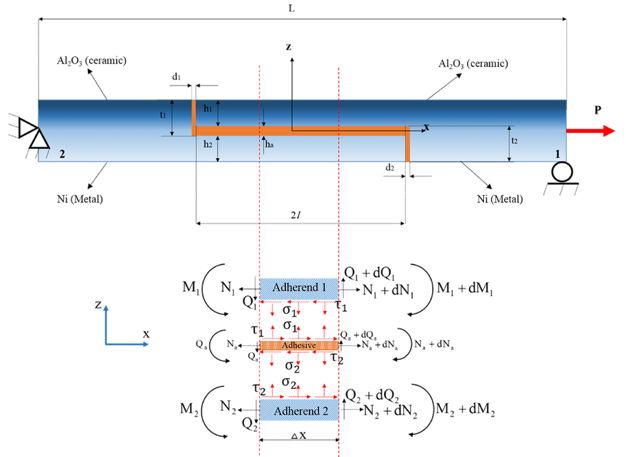
-
Tensile load applied along the axial direction of the joint.
-
Symmetry constraints applied where applicable to reduce computation time.
Load Conditions
-
Thermal environments: 20 °C (baseline) and 200 °C (critical).
-
Constant axial tensile loading applied in both scenarios.
Results Interpretation
-
At room temperature (20 °C), both elastic and viscoelastic adhesives produced almost identical, symmetric stress and displacement distributions, in agreement with analytical predictions.
-
At high temperature (200 °C), viscoelastic effects became dominant: stress distributions were nonlinear and asymmetric, with edge effects driving higher local stresses, and displacements of FGM components lost their symmetry.
-
These results demonstrate the critical role of temperature-dependent viscoelastic modeling in predicting realistic adhesive joint behavior. Traditional elastic assumptions are insufficient for high-performance applications.

? This study highlights the importance of temperature- and time-dependent modeling when designing adhesive joints in FGMs. Ignoring these effects could lead to overly optimistic predictions and premature failure in service.